 Hardly a Kindergarten session goes by without my sharing one of my illustrated books with the group. Often I start the class off with a book that is a springboard for the lesson. Sometimes, the lesson is a continuation of the week before so I select a book just for fun. This week students were completing a lesson and I had a new book that I was eager to share with them. I was fortunate to win this book in a drawing at an event this week. The author, Susan E. Goodman was the guest speaker. Entertaining and extremely knowledgeable would be two appropriate words to describe Ms. Goodman. I thoroughly enjoyed her presentation peppered with antidotes and humor. I loved this particular one and immediately chose it to share with my students. Ms. Goodman takes the reader on a journey back through time looking at the parcel of land that is currently New York City. My students were delighted with the illustrations and intrigued by the story line. I was impressed by their very insightful questions as they began to grasp the message of the non-fiction book. I loved sharing this book and my students were definitely engaged with the historical message. Check it out and many of the other books by Ms. Goodman.
Saturday, May 9, 2015
I love Children's Illustrated Books!
Hardly a Kindergarten session goes by without my sharing one of my illustrated books with the group. Often I start the class off with a book that is a springboard for the lesson. Sometimes, the lesson is a continuation of the week before so I select a book just for fun. This week students were completing a lesson and I had a new book that I was eager to share with them. I was fortunate to win this book in a drawing at an event this week. The author, Susan E. Goodman was the guest speaker. Entertaining and extremely knowledgeable would be two appropriate words to describe Ms. Goodman. I thoroughly enjoyed her presentation peppered with antidotes and humor. I loved this particular one and immediately chose it to share with my students. Ms. Goodman takes the reader on a journey back through time looking at the parcel of land that is currently New York City. My students were delighted with the illustrations and intrigued by the story line. I was impressed by their very insightful questions as they began to grasp the message of the non-fiction book. I loved sharing this book and my students were definitely engaged with the historical message. Check it out and many of the other books by Ms. Goodman.


Saturday, May 2, 2015
Symmetry and Monarch Butterflies
 With the Fiesta dance just a few days away, first graders needed to create a decoration that also incorporated some of the elements and principals of art. Symmetry seemed to be a good focus along with color and color mixing to create these dynamic Monarch butterflies. Students began the lesson by review knowledge achieved in Science class when they learned about the life cycle of the Monarch and it's migration habits with winters in Mexico. The monarch seemed to be a good focus for a Fiesta decoration in that these butterflies spent a good portion of their life in Mexico as well as most parts of the U.S. Students used red and yellow paint to make a symmetrical print. Week two, sharpie markers were used to add detail and eyes. Pipe cleaners became the antenna for the butterflies. These will also double as eye catching decorations for the upcoming dance.


Channeling Kandinsky

I will not take credit for this project idea, I found it on a fellow blogger's site Create Art with Me.

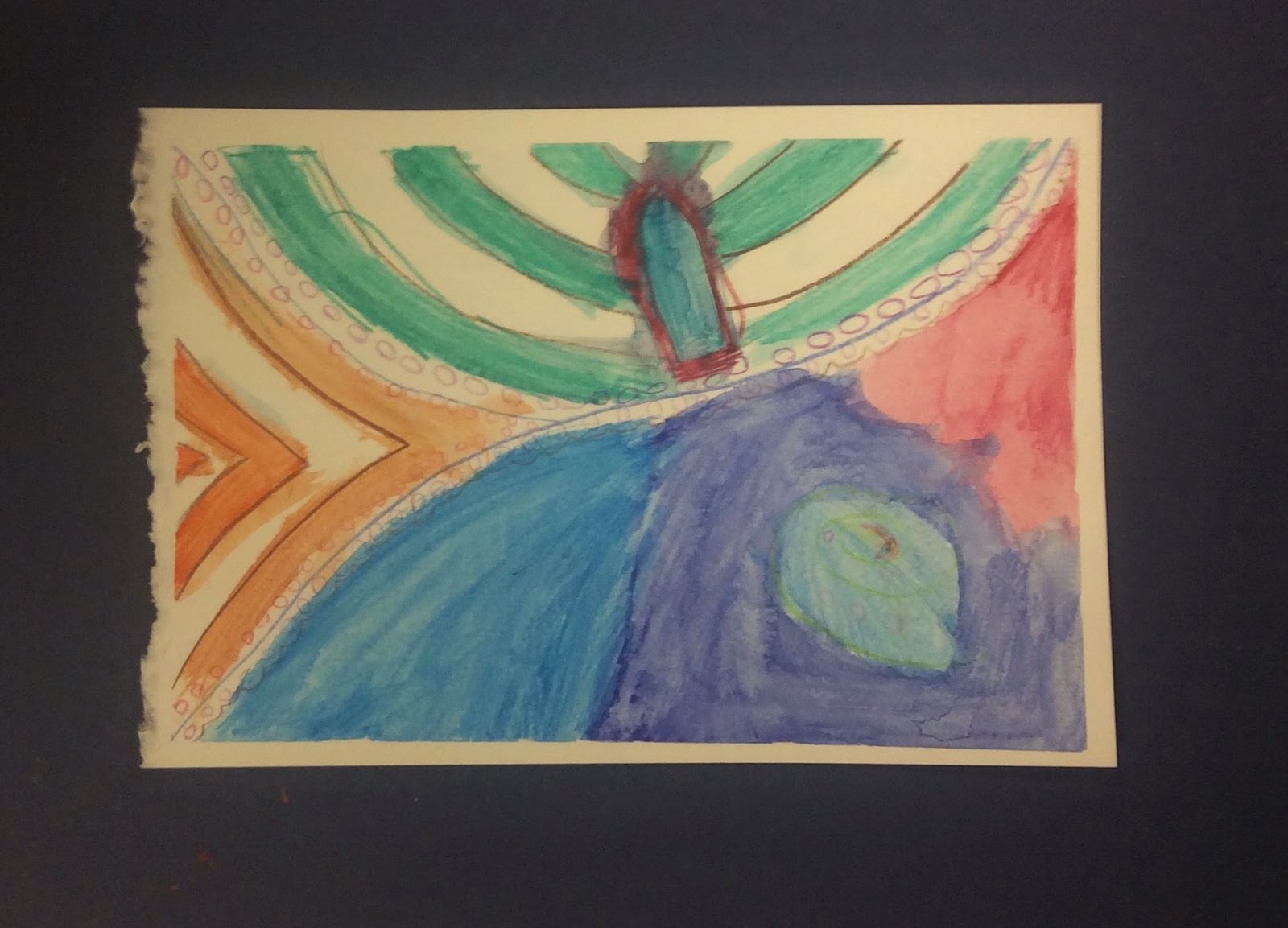 I had been exploring the work of Kandinsky with third graders when this lesson popped up on my blog feed. Students had practiced listening to the colors in classical movements and drawing with markers as the first process. I hadn't been sure I would be able to really achieve having them listening and creating successfully and had decided to test the waters, so to speak, with markers the first day. Week two, they progressed to watercolors as they listened to music and then I saw this post and knew a third lesson would need to be added to my plans. This lesson took a bit more direction and planning and more stop and starts. First I instructed students to only draw lines and shapes as they listened to the music using a basic color pencil. After about 4-5 minutes, the length of a musical selection, the pencils were put away and replaced with watercolor pencils. The instructions were to add color but not to color in the entire page. Students were reminded that this was not a coloring page and that in the third step we would be manipulating color and moving it so white space would be needed. Again the music played for a selection and then the watercolor pencils were traded for water and a small brush. Students were encourage to move the color thoughtfully and not to just add a water wash. I am really pleased with the variety of results obtained and can hardly wait until all the classes have finished so I can post these on the hallway bulletin board!


O'Keefe on a pyramid
 |
| photographed flat to capture the detail |
 |
| An assembled pyramid |
Lego Architect
Saturday, April 25, 2015
Fiesta!


Thursday, April 23, 2015
The Behaviors are Making me Crazy (and look old)!!!


I recently decided to try to draw a self portrait while looking into a make-up mirror and was alarmed at what my eyes were beholding. In just a few short months, talking about since my yearly school picture, my face has added an exorbitant amount of new wrinkles. How have I changed so much in just a few month, I thought with extreme alarm. Immediately, the answer jumped into my conscientiousness - it's the behaviors! This has been a very challenging school year. The top tier students have kept everyone on tippy toes and some days teaching has been impossible. After years of teaching I have found myself scrambling to find new methods and ideas to manage my classes. A first year teacher shared with me a book she had borrowed and was reading and I thought it might just be able to supply me with some answers. Luckily, I also knew of someone who owned the book and quickly sent out an email to see if I might borrow it. If you haven't read it yet, find a copy and give it some attention. The book is Classroom Management for Art, Music, and PE Teachers by Michael Linsin. Linsin had me within the first couple of paragraphs as he explained the purpose of the book. Seems Linsin was a classroom management authority of sorts; even offering professional development on the subject. He had been a classroom teacher for 15 years when he decided to switch over to teaching Physical Education. Within minutes of his first class, he knew classroom management as a specialist had an entire different look than it had for him as a classroom teacher. This book outlines his suggested methods of taking control of your classes even if you only see them once a week. It's a quick read with some insightful ideas and approaches. I found myself reflecting, reevaluating and congratulating myself as I read through each section. Some things I already did, some I definitely need to work on and in some areas I have a need to fine-tune. With that said, I strongly recommend you get your hands on a copy and give it a read. I think I'll be purchasing a copy for myself when I return my borrowed copy, to flip back through as a reference and a reminder. Hopefully, with better classroom management techniques, some of these wrinkles will soften and I'll start looking a little bit more like my old self. Oh, and this is not an advertisement, I received no compensation for this post You can also visit smartclassroommanagement.com for more information.
Subscribe to:
Posts (Atom)