
Tuesday, October 29, 2013
Dragon's Halloween Chap. 2
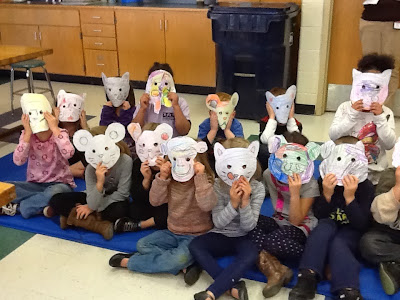
Dragon is invited to a Halloween party and can't decide what costume to wear. He ends up with a pumpkin splatting on his head and the scariest costume of all. Here Kindergarten students model mask for their imaginary participation at the party with Dragon.


Saturday, October 26, 2013
Day of the dead
 |
| student work |
 |
| student work |
 |
| student work |
 |
| student work |
Thursday, October 24, 2013
What can we stack?
 |
| Lots of pumpkin expressions |
These are projects from Chapter 1.
 |
| This one is a bit more haunted with the skeleton |
 |
| This is a great composition for 1st grade |
 |
| Once in a blue moon |
 |
| Such wonderful detail |
 |
| I love the moon in this one |
Hanging on to fall
Almost all the leaves are gone from the trees in our area. Third grade students hung on to a bit of the fall beauty with leaf prints today. First several leaves were stenciled onto a page creating a contour of the leaf. Immediately, more leaves were printed overlapping the first group by using watercolors. The prints are striking on their own but students suggested we extend the project by turning them into tree compositions next week. I'll post new photos next week to fill you in on how they turn out. For now, I really love these!
 |
| The vein work is beautiful on this one |
 |
| Heavier paint made a a more solid print |
 |
| the viens on this one are beautiful too! |
 |
| This student chose to only use red for the texture printing |
 |
| The composition is so interesting and flowing |
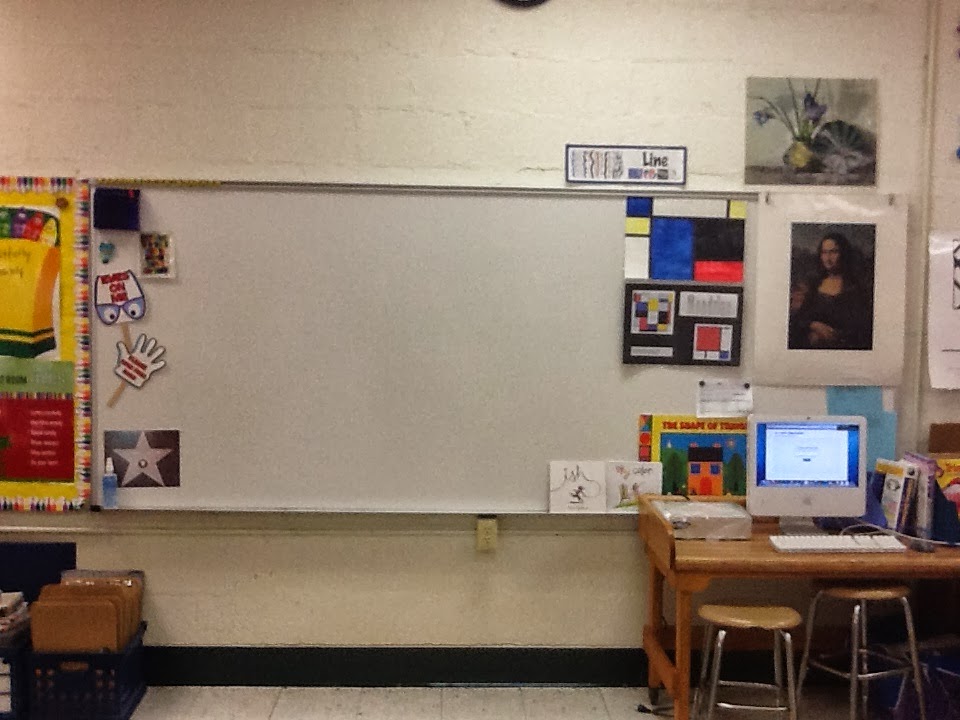
I have my whiteboard!
Monday, October 21, 2013
She was very busy spinning her web

With a focus on line and shape, students then created a web using a white crayon. Vocabulary included horizontal, vertical, diagonal, and angle. A black crayon was used to create the spider with circles that are colored in slowly around the edges to become dots. The magic of the lesson occurs as a liquid watercolor wash is applied over the compositions. The students were delighted with their busy spider creations.


Wednesday, October 16, 2013
Valupillars
Okay, that's not really a real word but it is what I have chosen to call this value project recently completed by fourth grade students. I was given a large quantity of white model magic that had been around for a few years. It was beginning to become a little stiff so needed to be used. I decided to turn this into a lesson on value, primarily tints. With a little blue model magic and a larger piece of white model magic, students started by dividing their clay into 5 approximately equal pieces. This would help them as they began mixing so they would be able to budget clay use. The first ball was a small blue one, then white and blue were mixed together to make an only slightly lighter ball of clay. Each ball of clay became progressively larger and lighter ending with a large white ball of clay that became the head of a Caterpillar. Thus, the name, Valupillar. Not only were the students totally engaged in the color lightening process to create the tints of blue, I also had comments that this as the best project ever!


Subscribe to:
Posts (Atom)